Raising a Reader: 6 Ways to Foster a Love of Reading in Children

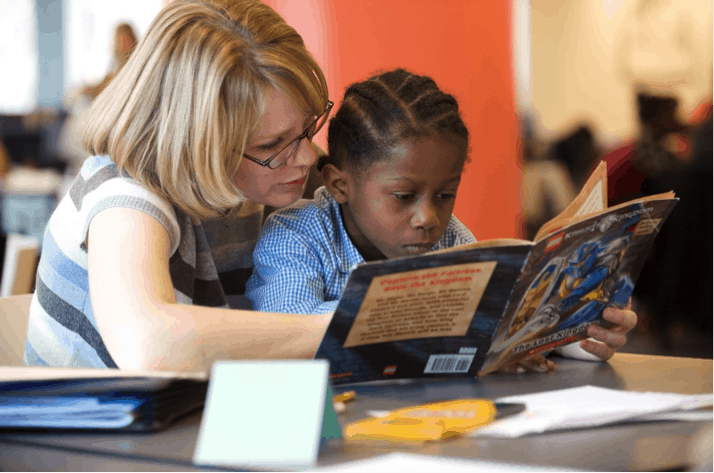
Lady reading to child

Image credit: Joshua Hoover, US Dept. of Education

While some children are born readers, who will thrust their nose into a book given any opportunity, other children are somewhat reluctant. 

In fact, we’ve all heard parents who describe their children as kids who “hate to read”.

At Book Village, we don’t believe any child hates reading – we just think that they haven’t found the right book yet. 

If this sounds like your child, don’t despair. We have a bunch of tips below on how to encourage (or trick) your little one into reading:

1. Read by example

It’s no accident that parents who love reading often pass this love on to their children. If you read regularly, instead of passing time in front of the TV or on your mobile device, your child is more likely to follow. 

2. Don’t quit bedtime-stories

Even once your child is old enough to read independently, they can still get great pleasure from being read to. 

This time is so important in terms of bonding, creating a positive feeling about reading and can be an opportunity for you to read longer novels that may be just out of your child’s reading ability. 

3. Reread old favourites

It’s perfectly natural for younger children to enjoy the same book over and over again – let them. Through repetition, they learn new words and correct grammar. 

4. Take turns while reading to your child

You read one page, they read one page. This way, your child gets to practice reading while enjoying the story. 

5. Let your child read whatever they want – no judgement

Even if the book is way below your child’s reading level! 

Reading should be a fun activity, so don’t limit them to novels or books without pictures. A comic book or a book of jokes still harbor many of the same benefits of reading as a longer, more involved book. 

6. Find a book that your child can relate to

This seems obvious, but so many children love to read stories that they can relate to, with characters who they can aspire to be like. 

This post from the Book Trust has a wonderful list of age appropriate books for different age groups of children under 14, and is a great place to start!

Above all, reading needs to be a fun and enjoyable part of your child’s every-day life. Reading shouldn’t be a chore or a punishment. Furthermore, reading for pleasure should be a no-judgement activity. 

Raising a reader starts at home. What are you reading today? 

Hector: A Boy, a Protest and the Photograph that Changed Apartheid

Photo cred: Robert Cutts

Inspired by Sam Nzima’s iconic photo of Hector Pieterson, author-illustrator Adrienne Wright has created a beautiful, graphic history book that brings the June 16th, 1976 Soweto school protests to life. This historic day is now celebrated as Youth Day in South Africa. 

The book is written as an oral history giving accounts from Hector, his older sister Antoinette and Sam, the photographer.  The powerful illustrations give a faithful account of an ordinary 12-year-old boy and his family living in Soweto, and accurately reflect their daily lives up to that terrible day.

The fire and energy of the protest is brought to life through the vivid, moving pictures – you can almost hear the beautiful Nkosi Sikelel’ iAfrika erupting from the pages.

Children from about age 9 will enjoy reading the book themselves, but this book is perfect to share with your children of any age.  Use it to start important conversations about equality today and the contributions that many brave people have made in the past.

Hector is available in hard cover from Amazon.

The author-illustrator Adrienne Wright grew up in South Africa and worked with Hector’s sister, Antoinette and the photo-journalist Sam Nzima while creating the book.  She now lives in America.

She has been an amazing help to us, going out of her way to get us a copy of Hector from a friend of hers in Jo’burg before Youth Day this year. Hector will be a great addition to the Cosmo City Primary library.

Some things that we loved while doing our research for this book included an interview with Adrienne which you can find here.

The author gives us insight into her creative process, including the writing and illustrating journey here

Finally, Adrienne’s image of George Floyd that she posted on Instagram was picked up by the New York Times in an article about artists responding to his death. This is a great achievement.

Our Favourite Stories for Primary School Children

Books in a row

Photo credThingamababy.

Who remembers jumping onto mom or dad’s lap for bedtime stories? 

That feeling of safety, comfort, love and the excitement to find out what happened to Augustus Gloop after he ate way too many sweets!

Back then, before we hit double digits, we discovered the gift that reading gave us. The gift that allowed us to experience new journeys, feel an array of emotions, and build our understanding of the world. All this, through ink and paper. 

As Stephen King said, ‘Books are a uniquely portable magic’ and through them we became time-travellers. A combination of written words and our imaginations took over, transporting us to new worlds.  

The Reading Journey

For most of us, our reading chapter started with someone reading to us. We craved our storytime and eventually, through the stages of learning to read, we began to pick up the books ourselves. 

We read storybooks full of pictures, that went onto short chapter books.

When the chapter books became too easy, we picked up novels that would keep us awake at night. Our desire to read and learn more about the world and ourselves took over – we began reading more complex stories. 

And before we knew it, we were absorbing the information in articles and journals. 

Bedtime stories became a thing of the past – but for many, a new stage in life means that we have become the reader to our own little ones, who are eagerly jumping into our laps for their stories. 

Their reading journey is beginning, much like ours did, and the enjoyment of the stories is there found in both the reader and the listener.

Book Village Recommends

Short stories by Julia Donaldson and Eric Carle were always, and are still, treasures in the bookshelf. 

From a cat soaring above the clouds in Room on the Broom to the cunning little mouse tricking a monster in The Gruffalo, Donaldson has been able to capture her audience no matter what age. 

Carle’s books too are page turners that create laughter, curiosity and inspiration. The Hungry Caterpillar and The Mixed-up Chameleon are just two examples of his captivating stories.

Longer Stories for the Not-So-Little Ones

However, if you crave longer stories with twists and turns where your evenings leap from one cliff hanger to the next, Roald Dahl will never disappoint. 

The all-time favourite Charlie and the Chocolate Factory is full of adventure and left its audience with valuable life lessons – as did most of these books. 

The BFG, MatildaJames and the Giant Peach are just a few of Dahl’s books that should be in your bookshelf, along with stories by Julia Donaldson and Eric Carle. 

If these haven’t been added to your bedtime collection already, you should be adding them before you get the chance to finish reading this sentence.

Struggling to find a library or a book shop that’s open during lock down? Visit our Facebook page and view the pinned post to find out how to access free E-books from the comfort of your own home!

Memories of a Grade 7 Book Club

Pile of several reading books

Image credit: Caro Wallis

About two years ago I held a weekly book club with interested Grade 7s at the wonderful Cosmo City Primary 1 library. 

I wasn’t sure what to expect from this awkward age group – my usual age to teach is Grade 3s, but I immediately found that I loved the group. 

They ranged from sophisticated teens to cute kids, with about the same number of boys and girls. The book club meetings were, out of necessity, rushed affairs – squashed in between eating lunch and the first period after break. 

It turned out to be the perfect length of time – there was always an urgency in the group with an atmosphere and energy more like that of an auction than a reading group. There were hurried recommendations or rejections from the kids, with a general scrambling for the most popular books before rushing back to class. 

The books they read were as varied as the children themselves and, like the children, some of them have stuck in my mind. There were the old favourites of Roald Dahl, Goosebumps and A Series of Unfortunate Events. Humour was a big hit – they loved anything by David Walliams and Francesca Simon. 

By far the most tatty, and so most loved, books in the library were the Diary of A Wimpy Kid series.

Some of the kids enjoyed non-fiction, and I am Malala by Malala Yousafzai really captured all their imaginations. The teen girls raced through books by Cathy Cassidy and Louise Rennison having moved on from their beloved Jacqueline Wilson and Judy Moody books of earlier grades. The biggest queue of both girls and boys was to read the South African story Whitney’s Kiss

So, from my home during lockdown, I’m trying to picture how things will be for this year’s Grade 7s.

There will be no group of kids squashed into the back office of the library for one – and probably the library will remain closed for a while due to the pandemic. 

What the Grade 7s (and other grades) will have though is access to a digital library through Book Village. 

Now, more than ever, there is an urgent need for access to literature and education materials in a digital format.

It may be that only children with their own devices at home will be able to read from the library until we are able to visit the school, but it’s a start. There are some really great books just waiting to be discovered; from learn-to-read to young adult titles in both ebooks and audiobooks. 

I can’t wait to see what the most “tatty” book of the digital library will be.

– Sarah

Sign Up To Be Part Of Book Village!

By signing up to become a volunteer, you will be among the first to hear when the Book Village app officially launches and have the opportunity to be among the first people in the world to start making an impact through the Book Village platform.